
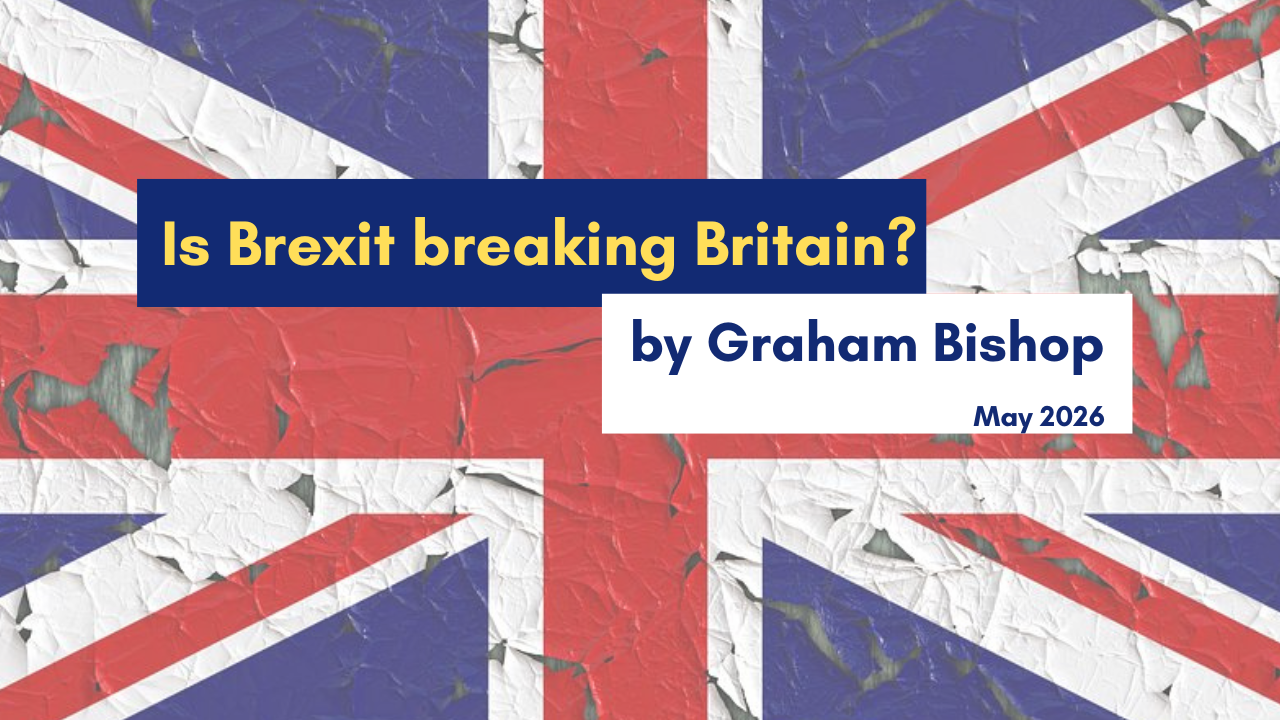

Update 19 May 2026: The challenge to Prime Minister Starmer has unexpectedly lifted the lid on the long-suppressed Brexit debate. But the political class (except for the Liberal Democrats) has immediately responded by trying to nail the lid down again rather than confronting the reality. The latest research shows that the UK has already lost about £400 billion of tax revenue since 2016 (a gap now growing at about £100 billion annually). This is why voters feel Britain is broken and the recent election underlined their demand for “change”. But the political class must “level” with electors and explain that the root cause is a self-inflicted wound – Brexit. ” Emperor” Farage has never had any economic “clothes”. Without Brexit and at current tax rates, the government would soon have no need to borrow any money at all! Dramatic “change” could have been financed.
Britain has obvious problems – is there a `quick fix’? Or have they been brewing for decades? Take a long run view over the 40 years from1985 – half an expected lifetime! That 40-year span included 1987’s Black Monday on Wall Street. A few years later the UK’s first “unset” from Europe arrived: Black Wednesday in 1992 when the “market vigilantes” threw the UK out of the ERM. This was the “foreign exchange” branch of the market vigilantes but the “bond market vigilantes[1]” showed their irresistible strength during the euro crisis of 2012. UK Prime Minister Truss had an unpleasant brush with them in 2022. Even President Trump seems afraid of them, and Chancellor Reeves certainly is as they move progressively into the driving seat of UK economic policy.
Brexit has steadily pushed them into that position of power by:
- Raising our vulnerability to an aging, and increasingly disabled, society where the non-immigrant labour force has scarcely risen in 40 years
- curtailing economic growth due to reduced immigration
- stalling business investment due to Brexit uncertainty – and thus productivity growth
- inducing a cumulative shortfall of tax revenue that is nearly £400 billion since 2016 – and may double by 2030. That shortfall will require a further rise in the tax ratio – to levels last seen in 1944;
- thereby creating a squeeze on public spending that is rending the fabric of British society – spending on the non-priority areas has fallen from 16% of GDP in 1985 to 10% today
- fuelling the deep concerns of the holders of Britain’s government debt – effectively giving “all the cards” to the bond market vigilantes
- creating political instability due to the manifest contradiction between large majorities who think Brexit was a mistake and the opinion polls showing that Reform will be the largest party after the 2029 General Election.
This lengthening list of the consequences of Brexit has created a serious and growing risk of a debt crisis. Extraordinarily – and unaware of the inexorable logic of this chain of events – electors presently seem likely to elevate one of the original (and leading) architects of this disaster to be Prime Minister, despite their historic repudiation at the last General Election of the political party that actually “Got Brexit done”.
Would re-joining the EU and joining the euro be an answer to our economic problems? The biggest political problem may be to convince the EU that we are serious about re-joining as they can read the opinion polls. What are the chances of Prime Minister Farage willingly leading the charge to re-join the EU and then join the euro??? Will the foreign bond market vigilantes leave him no option but to take the “road to Damascus” on this matter?

Notes
[1] Who are the “bond market vigilantes”? If a state needs to borrow money from “the market”, then in an open, international system, the market participants will decide if they wish to lend at the terms offered – or lend at all if they believe the risk of default is too great. At the end of the chain, those market participants are only seeking to ensure they can meet their own obligations to the ultimate beneficiaries – citizens/nations saving for their income in retirement.




This a welcome statement of what is becoming increasingly obvious to many parts of the British state – it was a grave mistake to be manipulated into leaving the EU by those who stood to gain – politically, economically, and personally – by those who led the anti-EU movement.
It is to the shame of the major political parties in the UK, with the possible exceptions of the Liberal Democrats and the SNP, that they seemingly refuse, either out of weakness of lack of insight, to re-engage with the Brexit issue. This is especially so when it seems clear that a majority of the British electorate now considers that Brexit was a mistake.
The longer a further referendum on re-joining the UE is delayed, the more opportunity it will give to the likes of Farage and Reform to further poison British politics with policies that will undermine, as with Brexit itself, the British state – and further push independence movements within the individual UK countries to bring an end to the UK. as a political entity
Graham, the summary of your paper suggests a typically thorough and timely analysis of one of the ways Brexit is indeed breaking Britain. I suspect there is another way, too, hinted at by the results of the recent local elections. Brexit is increasing the likelihood that the sub-divisions of the UK which voted in 2016 to remain in the EU (principally Scotland and Northern Ireland) will seek an alternative constitutional future. The prevailing wisdom suggests this pressure has diminished in recent years. I think otherwise.
Brexit is a mere pinprick in comparison to the combined destructive forces of QE and privatisation. Those two unnecessarily impoverishing policies have manufactured the biggest transfer in wealth for generations.
I don’t think anyone who votes for a populist party or who voted to leave the EU expects things to improve but we working classes have to do something short of revolution.
The leader of the EU Parliament has recently said the UK as a returning key member would not be in the same position as a new supplicant applicant. Also, no key EU figure has mentioned euro membership as a likely requirement for the UK. Despite the UK economic travails, the fact is sterling is still regarded as a hard currency – which creates no real difficulties for either European or UK exporters.
As John Stevens knows, I am not against eventual eurozone membership – but in strategic and tactical terms, this would be designed to make re-joining the EU that much more difficult. This is why the euro question is now routinely tactically raised by the Brexit advocates.