
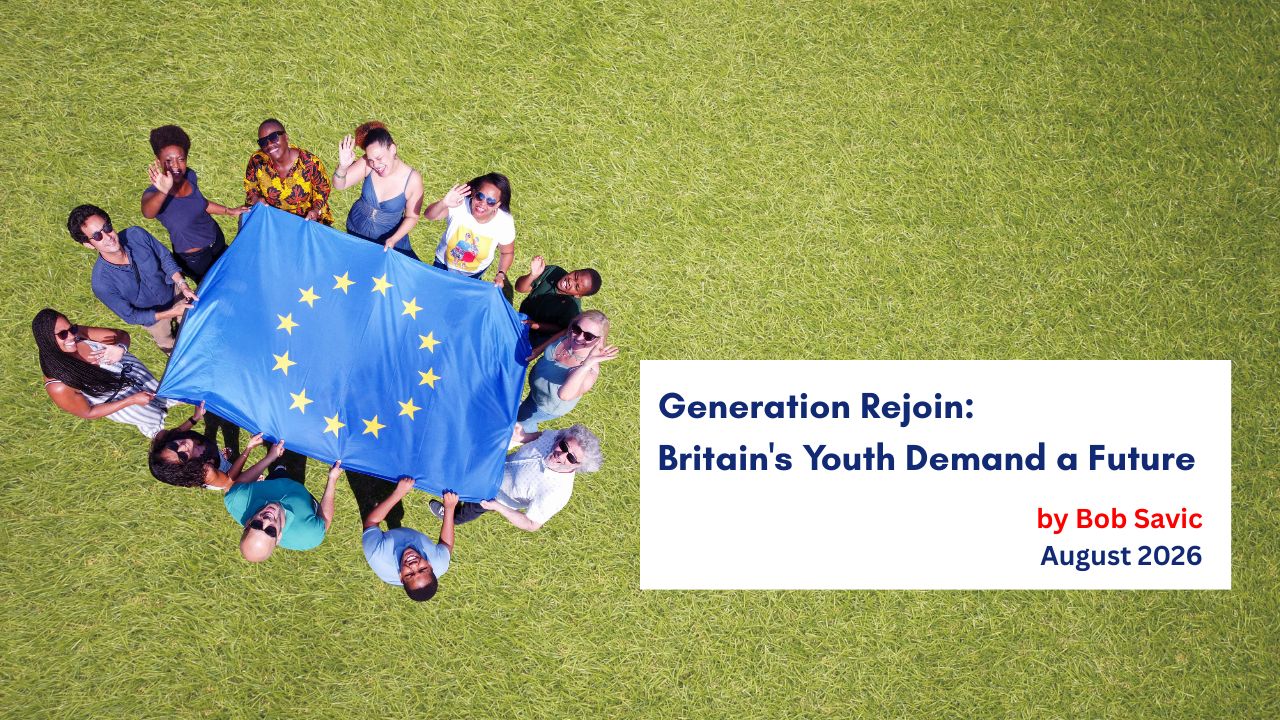

Recent polling and political discourse increasingly highlight a profound generational divide in the United Kingdom, with young British people emerging as the most fervently pro-European demographic since the 2016 Brexit referendum.
Public opinion on European integration has undergone a radical shift since Britain’s departure from the EU. While older demographics remain divided, younger Britons who were either too young to vote in 2016 and have come of age in post-Brexit Britain view the bloc as essential to their identity and future. Recent polling indicates an overwhelming consensus, with upwards of 80% of under-25s stating they would vote to re-enter the European Union if given a direct choice.
Facing a stagnant domestic economy with persistent low growth, Gen Z and millennial citizens view Brexit as a structural barrier to their career mobility and long-term prosperity. Young people acutely miss freedom of movement, which previously allowed seamless transitions for study, internships, and early career placement across 27 countries. Their desire to rejoin the EU is therefore not merely a nostalgic yearning for the pre-Brexit status quo; it is a pragmatic and urgent response to a domestic trajectory of low economic growth that, they rightly perceive, threatens systematically to foreclose their futures. The prevailing sentiment is that a Britain shackled by its own isolationist policies is a Britain that will fail them.
The economic rationale underpinning this youthful pro-Europeanism is stark and data-driven. Since the referendum, the UK’s economic performance has been characterised by sluggish productivity, anaemic wage growth, and chronic underinvestment. The macroeconomic reality of a post-Brexit United Kingdom includes estimates that the economy has shrunk by 6% to 8% compared to remaining inside the single market. For young people entering the workforce, this low-growth environment translates directly into diminished life chances and structural financial stagnation.
The Office for Budget Responsibility consistently forecasts a future of low growth, a reality that has a corrosive effect on the life chances of those just beginning their careers. For a young person today, the prospect of homeownership is a distant mirage, with average deposit requirements now exceeding the total annual earnings of a typical starter salary. This is not merely a property market issue; it is a symptom of an economy that has lost its dynamism. Brexit, with its attendant friction on trade, has erected barriers with the UK’s largest and closest trading partner, directly impacting the export-orientated industries that historically provided well-paying jobs.
Young Britons recognise that a future of low growth means a future of stagnant wages, which will keep them locked out of asset ownership and trapped in a precarious cycle of renting, a cycle that erodes their ability to save for retirement or invest in their own education and entrepreneurial ventures. The EU single market, by contrast, offers the scale and regulatory alignment necessary to attract the kind of foreign direct investment that drives innovation and job creation. Without this, British firms are smaller, less competitive, and less able to offer the career progression and salary increases that previous generations took for granted.
Beyond the macroeconomic statistics lies the tangible reality of opportunity. The European Union’s foundational principle of freedom of movement is, for the young, less a political ideal and more a practical gateway to personal and professional development. Before Brexit, the ability to live, work, and study seamlessly across 27 member states was a rite of passage, a means of acquiring language skills, building international networks, and gaining invaluable cultural capital. This is now largely denied to them.
Horizon Europe, the world’s largest collaborative research programme, is now largely off-limits, cutting British scientists off from crucial grants and partnerships. For a young researcher, this is not an abstract political gesture; it is the end of their career path
While some programmes like the Turing Scheme exist, they are a pale imitation of the Erasmus+ initiative, lacking the same depth, accessibility, and long-term integration with continental universities. This loss is not just cultural; it is economic. In a global economy, the most successful professionals are often those with international experience and cross-border competencies. By severing these ties, the UK has effectively built a wall around its young workforce, limiting their exposure to the largest pool of high-skilled jobs in their vicinity.
Low economic growth in Britain will only compound this problem, creating a domestic labour market with fewer opportunities for advancement, while the rest of Europe continues to attract the brightest and best from around the world. The young are acutely aware that their peers in Berlin, Amsterdam, and Dublin have a mobility and a freedom to pursue their ambitions that they no longer possess, a disparity that breeds a profound sense of injustice and thwarted potential.
Without a decisive political pivot toward full re-entry into the European single market, Britain risks cementing a profound intergenerational inequality. Older generations cast a vote that fundamentally altered the nation’s geopolitical alignment, while younger cohorts bear the compounding economic costs. Rejoining the EU is perceived by the youth not merely as an ideological preference, but as a mandatory correction to avoid economic obsolescence.
The desire of young Britons to rejoin the EU is therefore a logical and necessary response to a future they see as bleakly inevitable. They are not living in the past; they are looking at the demographic charts, the economic forecasts, and the international landscape, and they are drawing the only sensible conclusion. A Britain outside the single market is a Britain condemned to low growth, which in turn condemns them to low wages, high housing costs, and a shrinking pool of opportunities.
The promise of Brexit, which was sold as a liberation, has become a cage, and they are the ones locked inside. Their future in such a Britain will not simply be less prosperous; it will be less free, less open, and less hopeful. The call to rejoin the EU is therefore not a whim of youth, but a survival strategy, a plea to reclaim a future that is rightfully theirs, one defined by mobility, dynamism, and shared prosperity rather than by the slow, grinding failure of a nation that has chosen to turn its back on its neighbours and, in doing so, on its own young.



Leave A Comment