
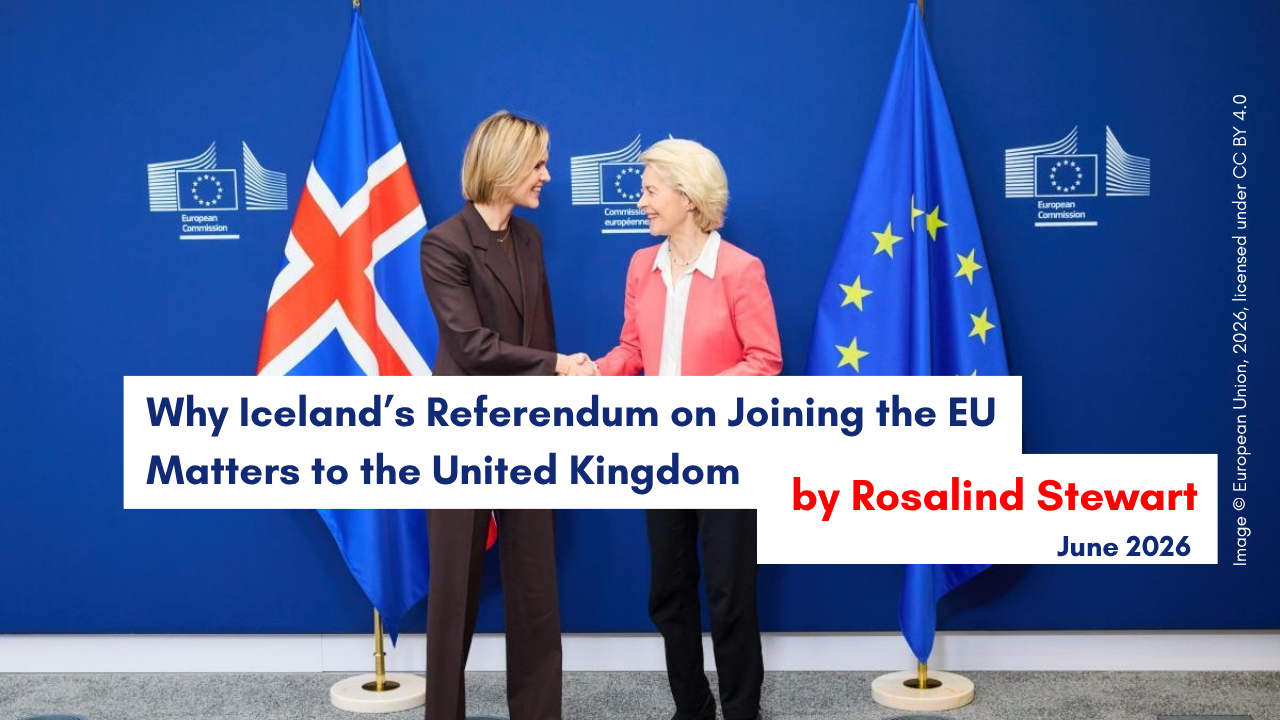

Readers will have noticed that the ‘omerta’ on Brexit has now ended, and the British media are now openly discussing the pros and cons of rejoining the EU. Politics never stays still, to quote an overused phrase, and the Brexit promised in 2016 is a far cry from what the UK is experiencing now. One new development is the upcoming referendum in Iceland on whether to restart the EU accession talks that were abandoned in 2015. Depending on the outcome of this referendum, this could set in motion a train of events that could affect the United Kingdom.
First, Iceland, a tiny but rich country in the North Atlantic, has been a member of EFTA, the European Free Trade Association since 1960, the EEA, or European Economic Area, since 1994, and NATO since 1949. So it is already well integrated with the EU, accepting the four freedoms of the Single Market: freedom of movement of capital, goods, services, and people. After the Global Financial Crisis in 2008, Iceland’s economy and currency were badly hit, and there was a majority of support for going the ‘whole hog’ and joining the EU, thereby getting a place at the decision table. However, talks broke down over fishing rights, and, as the economy stabilised and living standards improved, accession talks were then abandoned by the then new right-wing government in 2015.
However, the situation has altered, to put it mildly. Here are only a few points that have changed. NATO and the EU have a relationship based on the little-known Berlin Accords going back to 2002. The US, under Trump, is not the provider of military stability in NATO that it had been since its inception in 1949. Russia, now clearly on the backfoot in the ongoing war in Ukraine, could decide to re-group and invade other countries, if nothing else, to test NATO’s resolve. Ukraine could potentially win the war and be granted associated membership of the EU.
On the domestic front, the United Kingdom seems mired in extremely sluggish growth, excessive taxes, low productivity, and falling public services, among other economic woes. None of these internal problems were solved by Brexit. On the contrary, the UK is estimated to have lost an eye-watering 6-8% of GDP, or roughly £90 billion in the deficit, and many millions in daily tax revenue.
Iceland is now due to hold a referendum on restarting those talks in August 2026. At the moment, a plurality of Icelanders, 44%, favour joining the EU, with 36% opposed and the rest undecided. This compares with around 56% of British wanting to rejoin the EU, 35% opposed, and 70% of the general population favouring closer relations with the EU.
EFTA and the EEA
The three members of the EEA, including Iceland, re-grouped into EFTA in 1960. The other two members of EFTA are Norway and Liechtenstein. Switzerland declined EFTA membership, and its relationship with the EU is based on an endless series of re-negotiated treaties. Switzerland is not in the Customs Union, but does accept the four freedoms and is essentially a part of the Single Market. The Swiss model is not liked by the EU and is a source of friction within Swiss politics.
If Iceland restarts accession talks, and has a referendum on the final deal, which seems likely, that would leave Norway in a rather difficult position. It is, like Iceland, a very small but very rich country in the north Atlantic, and a member of NATO. With Iceland gone, Norway would be twinned with tiny Liechtenstein in EFTA, leaving the alliance precariously small. As Jonas Stein, a political scientist at the University of the Arctic Norway states “Technically it (EFTA) could survive. But politically it would look even more artificial.” (Arctic Today). Stein predicts that interest in joining the EU in Norway would rise considerably as a result.
So there could well be a situation in which both Iceland and Norway accede to the EU, and it would be hard to see how Liechtenstein would not follow.
A few other recent developments should be borne in mind: on 27 May, 2026, Norway agreed to be defended under France’s nuclear umbrella, the ninth country to do so. Sweden just agreed on 28 May to give 16 Gripen planes to Ukraine, with more to follow. On 21 May, Chancellor Merz of Germany suggested giving Ukraine associate membership of the EU. On 1 June, the Norwegian minister of defence, Tore Sandvik, said he was worried that Moscow could attempt to seize control of the ‘Bear Gap’ region between Norway and the Svalbard Archipelago, giving Russia a means of striking both the UK and Iceland directly with missiles such as the Zircon cruise missile. In other words, the NATO-EU alliance (without the US) is intensifying as the threats from Russia increase.
Domestically, the arguments to rejoin the EU have never been louder. With the potential if not probably upcoming leadership challenge in the UK, and Wes Streeting declaring his support for Rejoining, it is hard to see how the UK can avoid having a national debate about its membership of the EU, especially since tiny Iceland already is.

Leave A Comment