
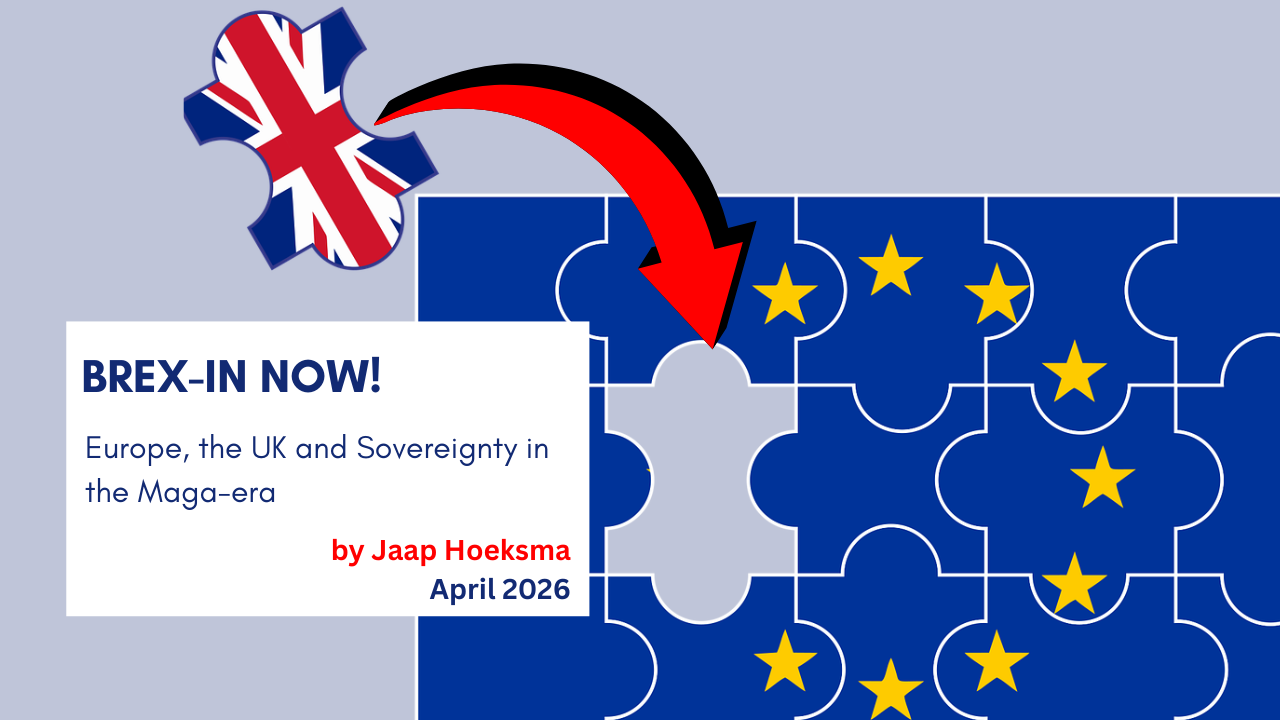

In the wake of PM Starmer’s decision not to participate in or contribute to illegal Israeli-American warfare against Iran, the UK has been hit by the unrestricted outrage of US President Trump. The alleged special relationship has all but evaporated. The Maga-President is lambasting the UK as hard as he criticises the EU for its European democracy. Faced with such unrestrained scorn, the UK and the EU should cooperate rather than further alienate from each other. High time for Brexing-in instead of staying outside the EU!
Rethinking Brexit
This obvious conclusion requires a critical rethink of the wisdom for the UK to leave the EU. The same forces that are condemning PM Starmer for his decision not to join the pre-emptive strike against Iran for being too soft on international law argued a decade ago that the European Union had become a European Super State intent on eroding British independence. After the implementation of the withdrawal the Prime Minister Johnson solemnly pronounced the ‘Liberation of the UK’. A couple of years later, the American president Trump branded 2 April 2025 as ‘Liberation Day’.
The point of European integration
The persistent allegations by the Maga-administration that the EU has been created ‘to screw America’ is not supported by any historical evidence. As the traditionalist forces in the UK tend to perceive international affairs through the same lens, it may be demonstrated that they are entirely missing the point of European integration. After the defeat of the Axis-forces in 1945 the old continent had to reinvent itself. Churchill led the way by calling for European cooperation. The shared objective of the founding states of the present EU was that they wanted to create an ever closer union among them. In theoretical terms, they replaced the traditional animosity between states with mutual trust. The implication of this revolutionary break with the past was that the participating states substituted a new model of thinking for the traditional Westphalian paradigm in international relations. Fully aware of their capability to destroy each other, they agreed to build a common future. Moreover, they wanted their future to be democratic.
From zero-sum game…
Unfortunately, this highly consequential paradigm shift in international relations has neither been noticed by political theorists nor by other scientific researchers of the process of European integration. Sir Edward Heath grasped the opportunities which the Single Market of the 60’s offered for the UK but academics continued to study the emerging European polity through the lens of a paradigm that the participants in the construction process had purposely abandoned. Leading British think tanks kept on arguing that the relations between states must be seen as a zero-sum game, in which the gains of one party must lead to the comparable losses from the other. A different strand of ideology insisted that the process of European integration had to result in the creation of a federal European state. As a result, they all failed to see that the EU was in the process of developing an altogether different approach to the concept of sovereignty.
…to the democratic principle in international relations
In effect, the academic establishment overlooked that the process of European integration was triggered from within by the democratic principle in international relations. In hindsight, the insistence on the applicability of outdated paradigms is the more astonishing as the participating states characterised themselves in the 1973 Declaration on European Identity as a ‘Union of democratic States, adding that they wanted to make their Union democratic too! Even after the Maga-attacks on European democracy and British sovereignty, traditional think tanks maintain that the UK has been right in ‘Taking Back Control’ and that democracy can only flourish within the borders of a sovereign State.
Inside Europe, however, a different paradigm informs the functioning of the polity and the relations between the participating states. The democratic principle in International Relations holds that when democratic states agree to share the exercise of sovereignty in ever wider fields with the aim to attain common goals, the organisation they set up for this must be democratic too! In line with this hypothesis, the member states have transformed their Union of democratic States over the years into a European democracy. Its political hallmark consists of its practical implementation of the principle that the shared exercise of sovereignty by the member states results in increased European sovereignty at the global stage.
Stages on the Road to European Democracy
European democracy is not a replica of a national system of governance but is geared to the needs of the states and peoples of a continent. Distinctive stages in its evolution include a) the transformation of the Parliamentary Assembly into a directly elected European Parliament (1976), b) the introduction of Qualified Majority Voting in a number of areas (1986), the establishment of EU citizenship (1992) and the introduction of the values of the Union (1997) and the Charter of Fundamental Rights of the EU (2000). Step by step the desire to create an ever closer union and the determination to make the Union as democratic as its Member States has been realised. As a result of their persistent effort, the EU can be identified in its current form as a democratic union of democratic states, in which the exercise of sovereignty is shared between the polity and its constituent parts.
BREX-IN!
Seen in this perspective, the British debate about Sovereignty is merely relevant for the theoretical domain of academics. In reality, the EU is already tasked to exercise sovereignty on behalf of the member states in the fields of foreign trade and monetary politics. Moreover, it enjoys sovereignty over its own system of democratic governance. Consequently, the debate about the application of sovereignty in the EU is no longer a matter of principle but rather of efficiency. Is it more effective for the member states to defend themselves separately against a common threat or are they better off by tasking their Union to do so? As British politics is equally under threat from Maga-ideologists as European democracy currently is, the UK Parliament will be well-advised to adapt its post-medieval concept of sovereignty to the realities of the 21st century. That may be a first step in the process of reconsidering Brexit and of normalising the relations with the EU. Bereft from a special partnership with the USA, being isolated from the European continent is not in the British national interest. Re-applying for membership of the EU is. BREX-IN rather than stay out!
The views expressed in this article are the views of the author only, and are not necessarily shared by the Federal Trust.

A limited but excellent summary of the present situation in Europe with respect to the UK. The direction being taken in USA politics makes it quite obvious that the UK’s future lies within two directions – (1) go it alone, or (2) a future as a member of the EU.
It must now be quite clearly seen that the decision of the UK to leave the EU was unequivocally not in the best interests of the UK, Subsequent political movements on both sides of the Atlantic since the UK’s withdrawal have shown the folly of the withdrawal and its undesirable consequences.
Without EU membership, democracy in the UK will suffer – as can be seen in the threats posed by ultra-right political parties in the UK and their desire to stay within the orbit of the USA (with the fallacy of a “special relationship” with the USA).
BREX-IN is very much in the present and future interests of the UK.